
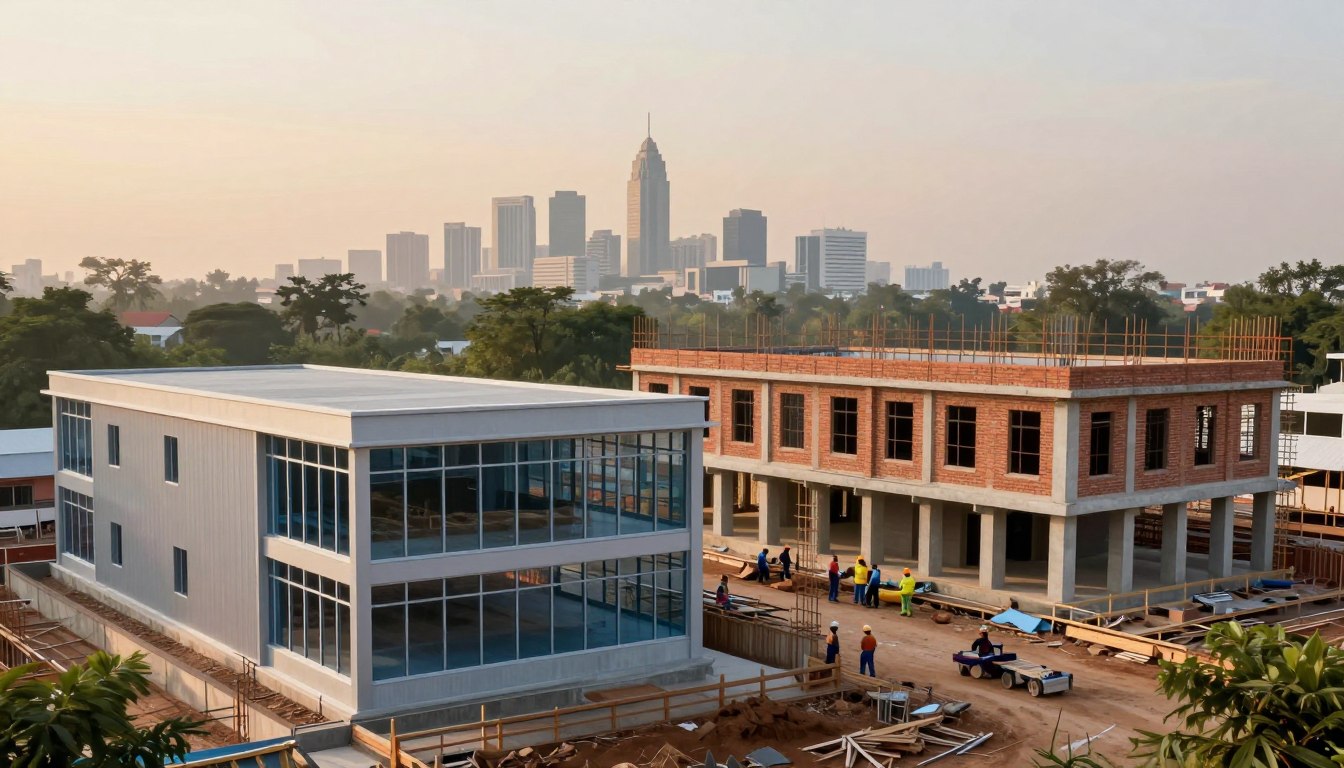
Choosing the right structure is key for any industrial project. As manufacturing changes, owners must decide between modern steel and traditional concrete.
It’s vital to understand the differences between PEB vs RCC Construction in Pune. This guide helps you make a smart choice for your facility. It uses local market data to match your goals.
Your choice affects your business’s future. We look at how these systems impact growth and efficiency today.
Understanding the Fundamentals of PEB vs RCC Construction in Pune
The industrial development in Pune is moving towards more efficient building methods. As Pune becomes a key manufacturing center, it’s crucial to compare PEB vs RCC Construction in Pune. This ensures the success of long-term projects.
Defining Pre-Engineered Buildings (PEB)
Pre-engineered buildings in India use a modern method. They are built in a factory with precise designs. Then, they are moved to the site for assembly.
This approach cuts down on-site mistakes and speeds up project completion. High-strength steel makes these structures strong yet light, unlike traditional methods.
Defining Reinforced Cement Concrete (RCC)
RCC construction involves pouring concrete on-site. It needs a lot of formwork and manual work. This method uses steel bars and concrete to build a solid structure.
Though tried and true, RCC is slow and prone to delays. Many still choose it for its strength and familiarity in Pune.
The Current Construction Landscape in Pune
Pune’s industrial area is changing fast to meet global standards. Developers must balance speed with durability.
The table below shows the main differences between PEB and RCC:
|
Featured
|
PEB Systems
|
RCC Construction
|
|---|---|---|
As Pune grows, the choice between PEB and RCC will affect new projects’ efficiency. Knowing these differences helps investors plan their construction strategy.
Comparative Analysis of Construction Speed and Efficiency
Time is crucial for any industrial project in Pune. Choosing the right construction method is key for success. Pre-engineered buildings India are popular for their speed. Knowing how they work helps businesses make smart choices for their buildings.
Timeline Advantages of PEB Systems
Steel structures are appealing because they are made in a factory. This means parts are ready to be bolted together on-site. This approach makes projects finish much faster than traditional methods.
The Traditional Pace of RCC Projects
The RCC construction process takes longer. It involves steps like formwork, reinforcement, and curing. These steps need a lot of time and labor, causing projects to take longer to start.
Impact of Pune’s Seasonal Weather on Construction Schedules
Pune’s weather, like the monsoon, is tough for concrete work. Rain can ruin the curing process and damage materials. Steel buildings, on the other hand, are not affected by weather because they are built dry.
|
Featured
|
PEB Systems
|
RCC Construction
|
|---|---|---|
Comparing construction speeds, steel buildings are faster to start making money. They save time by needing less on-site work and being less affected by weather. This speed is key for staying ahead in Pune’s fast industrial world
Cost-Effectiveness and Long-Term Financial Implications
When planning a new facility, the initial cost is just the start. A detailed PEB vs RCC cost analysis shows that the choice of structure affects your finances for years. Investors need to consider the total cost of ownership, not just the initial price.
Initial Capital Expenditure for PEB
Pre-Engineered Buildings offer a big advantage in the beginning. They use factory-made parts, which can cut the initial cost by 25–40%. This saves money upfront, letting businesses use funds for other needs.
Budgeting for RCC Infrastructure
Traditional concrete structures need a different financial plan. They require more labor and materials like cement and steel bars, leading to higher costs. Budgeting for these projects must also consider longer construction times, which can raise overhead costs.
Maintenance Costs and Asset Lifecycle
Success over time depends on a structure’s durability. Concrete is strong but may need repairs for cracks or weather damage. Steel, when treated right, has a clear maintenance plan, supporting cost-effective construction India goals.
|
Featured
|
PEB Systems
|
RCC Construction
|
|---|---|---|
Structural Durability and Performance in Pune’s Climate
Choosing between steel and concrete is crucial for industrial buildings in Pune. It affects how long and safe they last. Developers need to pick wisely to face local environmental challenges. The right choice ensures safety for 25 to 50 years.
Seismic Resilience and Structural Integrity
Pune faces different levels of seismic activity. This makes building strong and safe very important. Steel structures are better because they are strong yet light.
Steel is lighter than concrete, which means less stress on the foundation. This can make building cheaper because you need less digging and heavy concrete.
Thermal Insulation and Energy Efficiency
Keeping buildings cool in Pune’s hot summers is key. Modern buildings use insulated panels that keep the inside cool. These panels are better than old masonry at keeping heat out.
These panels help keep the inside cool without needing air conditioning. This saves energy and money all year.
Resistance to Environmental Factors and Corrosion
Buildings must withstand moisture and pollution. Steel is coated to prevent rust, even in humid weather. This keeps it strong and looking good for years.
Concrete is strong but needs upkeep to avoid damage. Steel with good coatings stays strong and looks good for decades.
Design Flexibility and Architectural Versatility
As business needs change, being able to change your facility is key. When looking at PEB vs RCC flexibility, think about how your space will grow. A building that can’t grow with you is more of a problem than an asset.
Customization Options with PEB Frameworks
Pre-Engineered Buildings offer a modular design that traditional methods can’t match. These structures make it easy to add on or extend without stopping work. This means your building can grow with your business needs.
Aesthetic and Structural Limitations of RCC
Traditional concrete buildings are hard to change once built. When comparing structural steel vs concrete, RCC often needs expensive demolition for big changes. This makes it hard for businesses in Pune to grow quickly.
Concrete is heavy, which limits design options. While it provides a strong base, it’s not as flexible as steel. This makes concrete buildings outdated faster than steel ones.
Space Optimization for Industrial and Commercial Use
Choosing the right warehouse building materials is crucial for space use. Steel allows for big open spaces, which means more room for work. This is a big advantage of steel in logistics and manufacturing.
Open floor plans help companies use their space better. Steel’s durability and flexibility mean your building can handle today’s needs and tomorrow’s growth. Here’s a table showing the main differences in design:
|
Featured
|
PEB Systems
|
RCC Construction
|
|---|---|---|
Regulatory Compliance and Local Building Standards in Pune
Understanding the complex rules is key for any construction project in Pune. Developers must follow local rules closely to avoid problems. This is crucial for Pune industrial infrastructure projects, which need to meet strict safety and zoning laws.
Navigating PMC and PCMC Building Norms
The Pune Municipal Corporation (PMC) and Pimpri-Chinchwad Municipal Corporation (PCMC) have strict rules for new buildings. These rules cover everything from how much space you can use to fire safety. Keeping up with these rules helps avoid delays and saves money.
To make sure your project follows the rules, you need to prepare certain documents:
Permitting Processes for Steel vs Concrete Structures
Getting a building permit Pune authorities require can differ based on the material. Concrete projects take longer because of the curing and testing needed. Steel buildings, with their standard designs, get approved faster.
Steel structures are often pre-certified, making the approval process easier. Since they’re made in controlled environments, their quality is easier to check. This makes steel a good choice for those looking to save money in cost-effective construction India markets.
Sustainability and Green Building Certifications
Today, developers focus on sustainable building Pune to reduce their environmental impact. PEB systems help by reducing waste through precise factory work. This makes it easier to get green certifications.
Using recyclable and energy-efficient materials helps meet national sustainability goals. These practices are good for the environment and increase property value. Starting with these standards early ensures your building meets local and global green building standards.
Conclusion
Choosing the right building method is key. It depends on what you need now and what you’ll need later. The PEB vs RCC Construction debate in Pune is about balancing costs and benefits.
Looking at the costs, steel systems are better for industrial warehouses. They are fast to build, helping you stay ahead. Steel wins when you need a quick construction.
Think about how easy it is to change your space with steel. It’s more flexible than concrete. This means your building can grow with your business in Pune.
Work with skilled engineers to pick the best building method for you. They help you follow local rules and make your building last long. Your next project should be efficient, strong, and well-designed.
About
At ITV Projects, we specialize in delivering innovative, reliable, and cost-effective construction solutions tailored to modern infrastructure needs. With expertise in PEB (Pre-Engineered Building) and RCC construction services in Pune, our team helps businesses choose the right building approach based on durability, project timeline, budget, and future expansion requirements.
From industrial facilities and commercial spaces to large-scale infrastructure projects, ITV Projects focuses on quality engineering, efficient execution, and long-term structural performance. Our commitment is to provide construction solutions that are strong, sustainable, and built for tomorrow.
FAQs
Both PEB and RCC construction have unique advantages. PEB is preferred for faster completion, lightweight structures, and large industrial spaces, while RCC is ideal for projects requiring heavy load-bearing capacity and traditional concrete structures. The right choice depends on your project requirements, budget, and timeline.
The main difference between PEB and RCC construction is the building method. PEB uses factory-manufactured steel components assembled on-site, resulting in quicker installation, whereas RCC uses reinforced concrete and steel bars constructed mainly at the project location.
Yes, PEB construction can be more cost-effective for many industrial and commercial projects because it reduces construction time, labour requirements, and material wastage. However, the final cost comparison depends on building size, design complexity, and usage.
Companies in Pune prefer PEB buildings because they offer faster project delivery, flexible design options, easy expansion possibilities, durability, and efficient space utilization, making them suitable for warehouses, factories, and industrial facilities
Yes, ITV Projects provides end-to-end PEB and RCC construction solutions in Pune, including planning, engineering, project execution, and construction support to deliver strong and efficient infrastructure solutions.

Copyright © 2026 – ICON Turnkey Ventures LLP | Created & Crafted By Right Click Solution
WhatsApp us